


Genetic and Prenatal Diagnosis Center of Affiliated Hospital of North Sichuan Medical College was established in 2013. It was the first medical institution in the Northeast Sichuan region to possess qualifications for prenatal diagnosis. The Center commenced cytogenetic prenatal diagnosis technical services in March 2014 and initiated molecular genetic prenatal diagnosis services in December 2019. In December 2022, it was approved as the "Nanchong Prenatal Diagnosis Center." In September 2025, it was further approved as the "Nanchong Prenatal Diagnosis and Screening Quality Control Center."
The Center is equipped with various specialized units including the Prenatal Screening Consultation Clinic, Eugenic Genetic Counseling Clinic, Interventional Prenatal Diagnosis Operating Room, Prenatal Screening Laboratory, Cytogenetics Laboratory, Monogenic Disease Molecular Genetics Laboratory, High-Throughput Sequencing Laboratory, Prenatal Diagnosis Information Center, and Archives Room. It boasts large-scale advanced equipment such as the ABI 3500DX genetic sequencer, Illumina 550AR next-generation high-throughput sequencer, and fully automated chromosome scanner. A strong technical team comprising clinical and laboratory personnel, including several doctors and masters with intermediate and senior professional titles, provides patients with high-quality and accurate services. These services include premarital genetic counseling, preconception counseling, eugenic genetic counseling, prenatal screening, interventional prenatal diagnosis, cytogenetic prenatal diagnosis, and molecular genetic prenatal diagnosis. Integrating clinical practice, scientific research, and teaching, Prenatal Diagnosis Center has made significant contributions to the three-tiered prevention of birth defects and the improvement of birth population quality in the Northeast Sichuan region.
Contact Information:
Office of Prenatal Diagnosis Center : 0817-2598427, 0817-2598155
Cytogenetics Laboratory of Prenatal Diagnosis Center : 0817-2190067
Molecular Laborator of Prenatal Diagnosis Center y: 0817-2598158
Biochemical Immunology Laboratory of Prenatal Diagnosis Center : 0817-2190069
Address: 4th Floor, Outpatient Department, No. 63 Wenhua Road, Shunqing District, Nanchong City.
Current Main Diagnostic and Testing Services:
1. Eugenic Genetic Counseling / Genetic Counseling Clinic:
(1) Analysis and strategies for eugenic genetic issues: Premarital counseling; preconception guidance; pre-pregnancy and prenatal eugenic counseling; consultation on the impact and management of genetic and non-genetic diseases on marriage, pregnancy, and the fetus; consultation on the impact of consanguineous marriage on offspring.
(2) Diagnosis and prenatal diagnosis of birth defects and genetic diseases: Diagnosis and prenatal diagnosis of chromosomal disorders and some monogenic disorders.
(3) Consultation on the impact and management of adverse environmental factors on the fetus: Consultation on the effects of physical factors (e.g., radiation) and chemical factors (e.g., drugs, toxins) on fetal development and teratogenicity; interpretation and counseling of eugenic infection marker results.
(4) Etiological diagnosis and treatment of spontaneous abortion, particularly recurrent spontaneous abortion.
(5) Genetic testing of fetal tissue from abortions and induced labor.
(6) Counseling for infants and young children with structural abnormalities, developmental delays, functional impairments, and other suspected genetic conditions.
(7) "Internet-based Medical Services" for eugenic/genetic counseling.
2. Pre-pregnancy and Prenatal Eugenic Examinations
TORCH testing, including Cytomegalovirus and Toxoplasma IgG avidity testing, etc.
3. Down Syndrome Screening (Second Trimester Down Syndrome Screening)
4. Non-Invasive Prenatal Testing (NIPT) via Maternal Peripheral Blood Fetal Cell-Free DNA
Significance: Assesses the risk of the fetus having common trisomies 13, 18, and 21, providing reliable clinical reference information for doctors and scientific reproductive advice for expectant parents.
5. High-Throughput Low-Pass Whole-Genome Sequencing (Copy Number Variation Sequencing, CNV-seq)
CNV-seq is a novel high-throughput sequencing-based method for detecting chromosomal disorders. It can analyze various sample types (e.g., peripheral blood, chorionic villi, amniotic fluid, umbilical cord blood, products of conception) to detect aneuploidy of all 23 chromosome pairs and chromosome copy number variations (CNVs) larger than 100 kb in a single test. It serves as a first-line prenatal diagnostic technique.
6. Full-Visualization Amniocentesis (Fig1)
The Center performs amniocentesis under continuous real-time ultrasound monitoring. This allows dynamic observation of fetal movement during the procedure, improving puncture success rates, reducing the occurrence of blood-tinged amniotic fluid, and enhancing the success rate of amniotic fluid cell culture.
7. Peripheral Blood Cell Culture, Chorionic Villus Cell Culture, Amniotic Fluid Cell Culture, Umbilical Cord Blood Lymphocyte Culture & Chromosome Karyotype Analysis, Bone Marrow Chromosome Karyotype Analysis
8. Products of Conception Testing
9. Prenatal Imaging Screening and Diagnosis (Ultrasound Department, Imaging Department)
Fetal Systematic Ultrasound, Fetal Echocardiography, Targeted Fetal Ultrasound, Fetal Magnetic Resonance Imaging (MRI)
10. Y Chromosome Microdeletion (AZF) Testing
11. Thalassemia Gene Testing
12. Spinal Muscular Atrophy (SMA) Gene Screening
SMA is the leading cause of infant mortality among autosomal recessive genetic disorders. It is a group of neuromuscular diseases characterized by degeneration of spinal anterior horn cells, leading to symmetric muscle weakness and atrophy, representing a common fatal motor neuron disease. The carrier frequency is approximately 1/50 to 1/35. If both partners are carriers, the risk of having an affected child is 1/4 for each pregnancy (approximately 80% die before the age of 4).
13. Carrier Screening for Common Monogenic Disorders (12 Diseases)
This project screens for 12 high-incidence genetic disorders (including thalassemia, SMA, DMD, hepatic steatosis, phenylketonuria, etc.) involving 21 core pathogenic genes. Utilizing next-generation sequencing technology, it screens for recessive pathogenic gene carriers within the normal population to prevent the birth of children with monogenic disorders and reduce the birth defect rate.
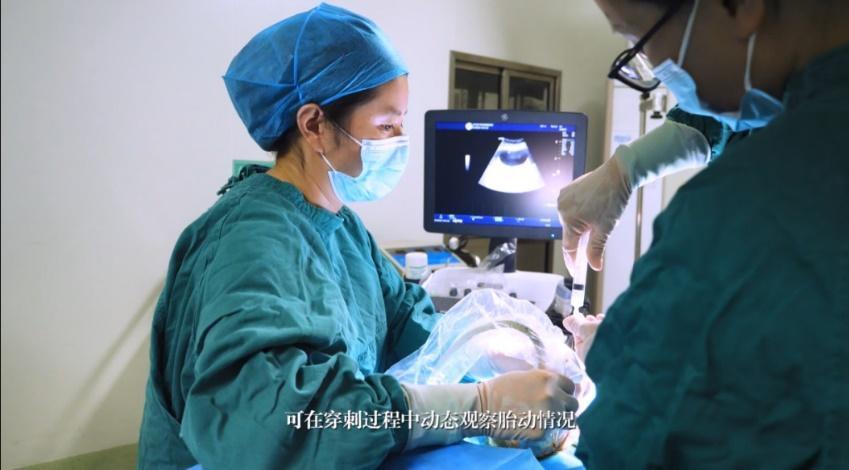
Fig1 Ultrasound-monitored Amniocentesis
This Center accepts referrals of pregnant women requiring genetic counseling and prenatal diagnosis from lower-level medical institutions.